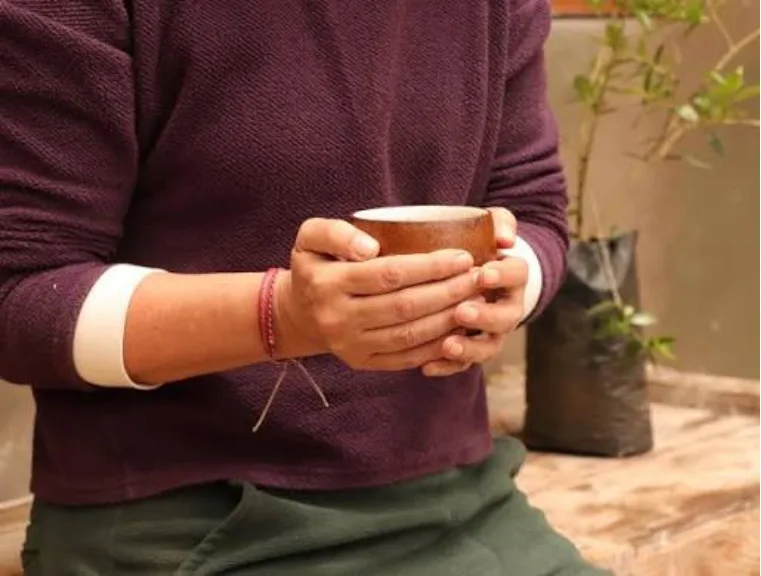
In almost every family, there’s someone everyone calls when something breaks. The one who lends the money, the one who goes with you to the clinic, the one who listens at 2am, the one who fixes things. If you’re reading this, you probably know who that is in yours. And it might be you. The question almost no one asks that person is simple: who holds you up?
What stays with you when you listen
In Does Trauma Live Only in Your Mind?, I talked about how mind and body work as a two-way system. That mechanism doesn’t stay inside a single person. When you repeatedly listen to the pain of someone close to you, your own nervous system does the same dance. You absorb part of their activation, even if nothing happened to you.
Karen Saakvitne and Laurie Anne Pearlman gave this a name in therapists who worked with trauma survivors: vicarious trauma. They described how, after accompanying a lot of someone else’s pain, the way a person sees the world, other people, and themselves changes. The world becomes a more dangerous place, people less trustworthy, rest harder to find.
The concept was created to describe professionals. But the mechanism doesn’t check your job title. It’s lived by the mom who holds up a child in crisis while working and running the household. It’s lived by the provider who carries the debts and the fear of the whole family. It’s lived by the eldest child who, without anyone deciding it, became the one who fixes everything in a dysfunctional home.
Compassion fatigue
Charles Figley, one of the pioneers in this field, coined the term compassion fatigue to describe the toll on those who accompany people who are suffering. Later, Beth Hudnall Stamm divided it into two components worth distinguishing.
The first is burnout: the physical, mental, and emotional exhaustion that comes from a load sustained over time. It’s the kind of tiredness a weekend doesn’t fix. The second is secondary traumatic stress: symptoms similar to post-traumatic stress, but from what you lived through someone else. Images that come back, being on alert for no clear reason, avoiding certain topics or places.
What I find important is that neither one means you’re weak or that you’re not cut out to hold others up. It’s the same neurobiological mechanism that works in anyone. If your nervous system is constantly exposed to pain, it’s going to react. It’s not a character flaw, it’s something to be expected.
Why you don’t see it coming
People who hold others up almost never notice when they start to wear down. First, because there’s no time: there’s always something more urgent than your exhaustion. Second, because the signs are subtle. You become more irritable, you enjoy less of what you used to like, you feel that everyone asks things of you and no one asks about you. And when you finally notice, the guilt shows up: how can I be tired when they’re the ones having a hard time?
There’s something deeper. Over time, the role becomes identity. Like Diego in What You Think Is Your Personality Might Be a Memory, a strategy that worked turns into “that’s just how I am”: I’m the strong one, I’m the one who doesn’t break, I’m the one who doesn’t need anything. And if that’s who you are, asking for help feels like no longer being yourself.
That role often has a history too. The person who holds everyone up today is usually the one who learned as a child that their needs could wait, because something or someone else was more urgent. Holding others up became their way of staying safe and being loved.
Holding others up without disappearing
It’s not about stopping. Wanting to take care of your people isn’t the problem, it’s part of what makes you who you are. The question is a different one: in everything you’re holding, is there room for you?
In my profession, this isn’t optional. Those of us who work with trauma need supervision, limits on the load we take on, and our own therapy. Not because we’re fragile, but because we know no one is immune to emotional overload, not even those who understand it. If it’s hard for someone who knows the mechanism, imagine how hard it is for someone who has never heard of it.
Outside the therapy room, this translates into things that are simple but hard: releasing the tension you build up after a heavy day, saying no once in a while without giving a thousand explanations, and having at least one place where you’re the one who gets to talk. The tools in Your Window of Tolerance work just as well for you as for the person you’re supporting.
Maybe the hardest part is accepting that taking care of yourself doesn’t take anything away from anyone. On the contrary, it’s what lets you keep holding others up without breaking along the way.
So I come back to the question from the beginning: who holds you up? And if the answer takes a while to come, what does that tell you?
References
Figley, C. R. (1995). Compassion fatigue: Coping with secondary traumatic stress disorder in those who treat the traumatized. Brunner/Mazel.
Saakvitne, K. W., & Pearlman, L. A. (1996). Transforming the pain: A workbook on vicarious traumatization. W. W. Norton & Company.
Stamm, B. H. (2010). The concise ProQOL manual (2nd ed.). ProQOL.org.